

Georgia Tech Sustainability Experts Convene at Super South Conference
Georgia Tech sustainability experts, faculty, and students joined partners at Super South – the Atlanta-based summit that unites global visionaries around transformative and resilient solutions.
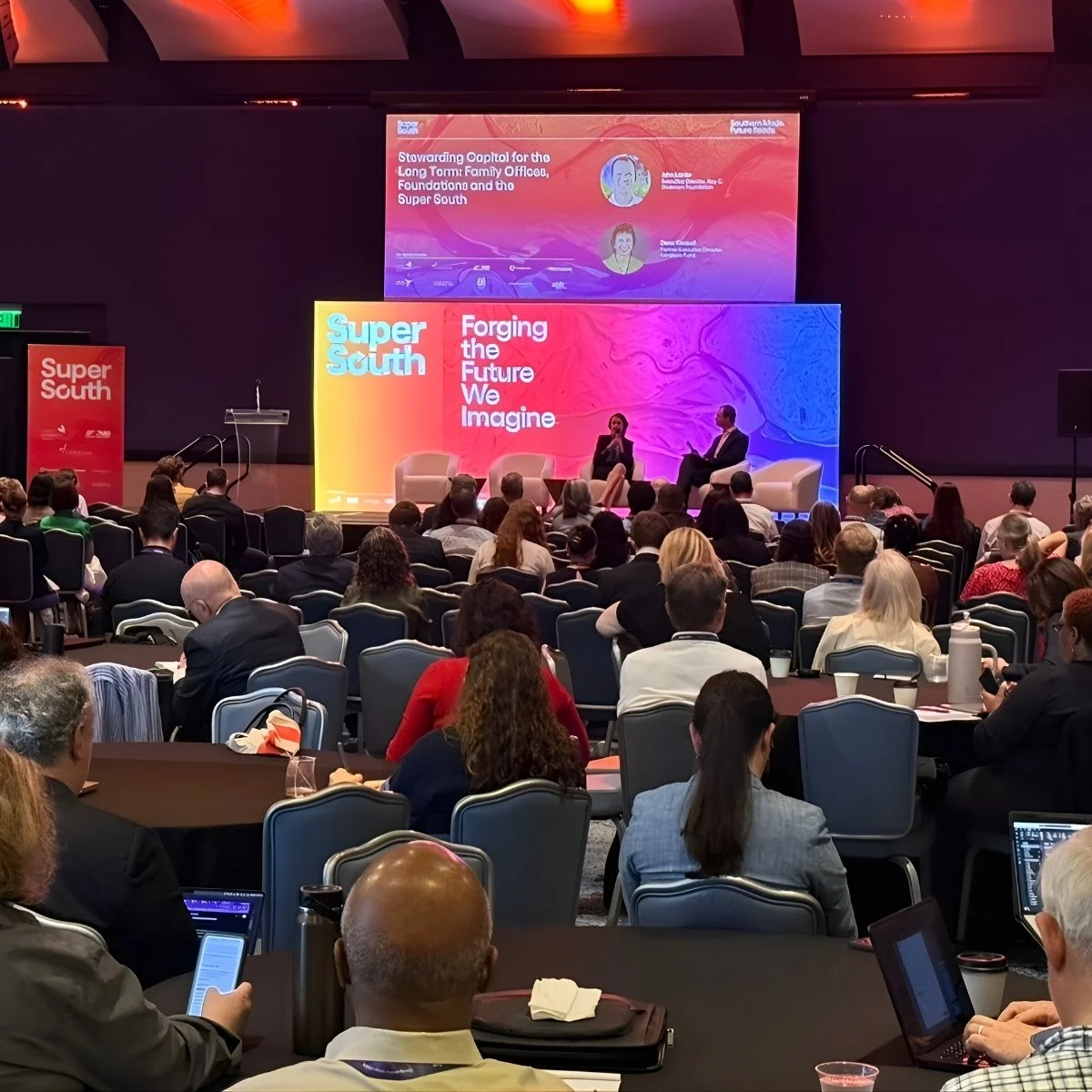
2026 Super South conference
Georgia Tech sustainability experts, faculty, and students joined partners at the Georgia Aquarium from March 30 through April 1 for the Super South conference. The Atlanta-based summit unites global visionaries around transformative and resilient solutions. For the second consecutive year, the Ray C. Anderson Center for Sustainable Business (Center) at the Georgia Tech Scheller College of Business and the Drawdown Georgia Business Compact (Compact) served as a co-sponsor, bringing together Georgia Tech’s sustainable innovation ecosystem – from cleantech startups and carbon market research to green finance education and community engagement.
Green Finance: Banking on the Future
On the opening evening, the Georgia Cleantech Innovation Hub and Emory University hosted the NextGen Finance Social in partnership with the Center, the Compact, the Brook Byers Institute for Sustainable Systems (BBISS) at Georgia Tech, the New York Climate Exchange, and B Local Georgia. The student-focused event connected emerging changemakers with professionals shaping the future of environmental finance and climate innovation.
In her opening remarks, Beril Toktay, executive director of BBISS, captured the spirit of the gathering: “We are banking on the future. We’re looking to create opportunities for tomorrow’s business leaders and entrepreneurs to find their community, find their calling, find their network and resources – and to develop the skills they need to make an impact in this space.” Panelists from Cherry Street Energy, Cox Enterprises, and EY shared career lessons alongside real-time opportunities, including internships – a reflection of what organizers called “ideas turning into action.”
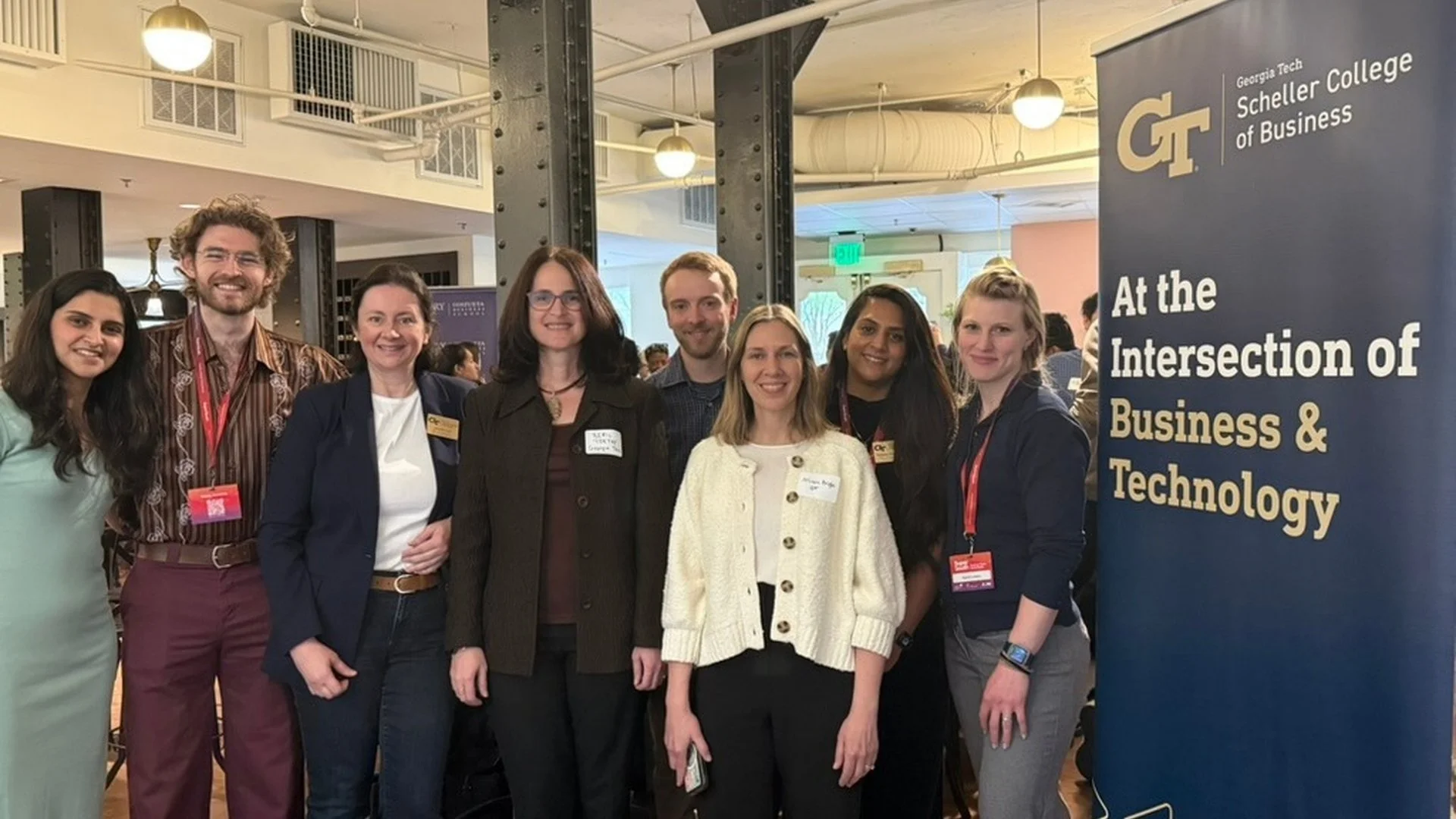
Organizers of the NextGen Finance Social with the Center team.
Building What Lasts: Georgia Tech’s Engine for Sustainable Innovation
A panel conversation explored how Georgia Tech’s interconnected institutes, research, and programs are translating sustainability ideas into real-world impact. Moderator David Eady, the Center’s director of industry engagement, framed the discussion with a central question: “What is the future we imagine at Georgia Tech, and how can we make sure the future is sustainable and just for all?”
Andre Calmon, faculty director of the Center, described the Center’s three-pronged approach. He said, “A lot of the work we do is focused on developing talent around sustainability, making connections between industry and Georgia Tech, and developing knowledge around the Georgia Tech ecosystem.” He highlighted the Institute’s entrepreneurial momentum (launching approximately 150 startups per year) and its role as a connector through initiatives like the Drawdown Georgia Business Compact.
Beril Toktay emphasized the transdisciplinary nature of BBISS’s work: “Some of the biggest issues we’re facing can’t be solved by one discipline alone.” BBISS focuses on human security (which includes aspects such as affordable housing, clean air, nutritious food, and resilience to climate events) by forming interdisciplinary teams around themes where Georgia Tech excels, such as flood resilience, urban planning, and infrastructure resilience.
Regents’ Professor Marilyn Brown offered an update on Drawdown Georgia, a multi-university research project launched in 2018 that created a localized roadmap of climate solutions and a greenhouse gas tracker for the state. Georgia has made substantial progress since 2005 – its carbon footprint has been cut roughly in half. However, as Brown noted, the situation is growing more complex. “A few years ago, it looked rosy. Now we’re trying to reimagine the future – more of a spread of possibilities rather than a definitive one.” The project is now expanding its scope to examine policy drivers and the geography of investments, including EV charging infrastructure and grant activity.
Brown also highlighted troubling statistics. While Georgia ranks as a major manufacturer of cleantech solutions like modern mini-split heat pumps and solar panels, it ranks in the bottom half of U.S. states in adoption of these same technologies. “There is a disconnect between our role in manufacturing versus adoption,” she said, adding that Georgia carries one of the Southeast’s highest energy burdens. “We need to better communicate solutions. Also, when we’re manufacturing solutions, we need to consider modifications to make them more affordable for low- or mid-income earners and renters.”
Despite the challenges, all the panelists found reasons for optimism. Calmon pointed to students: “They are the reason why a lot of us get up and go to work in the morning.”
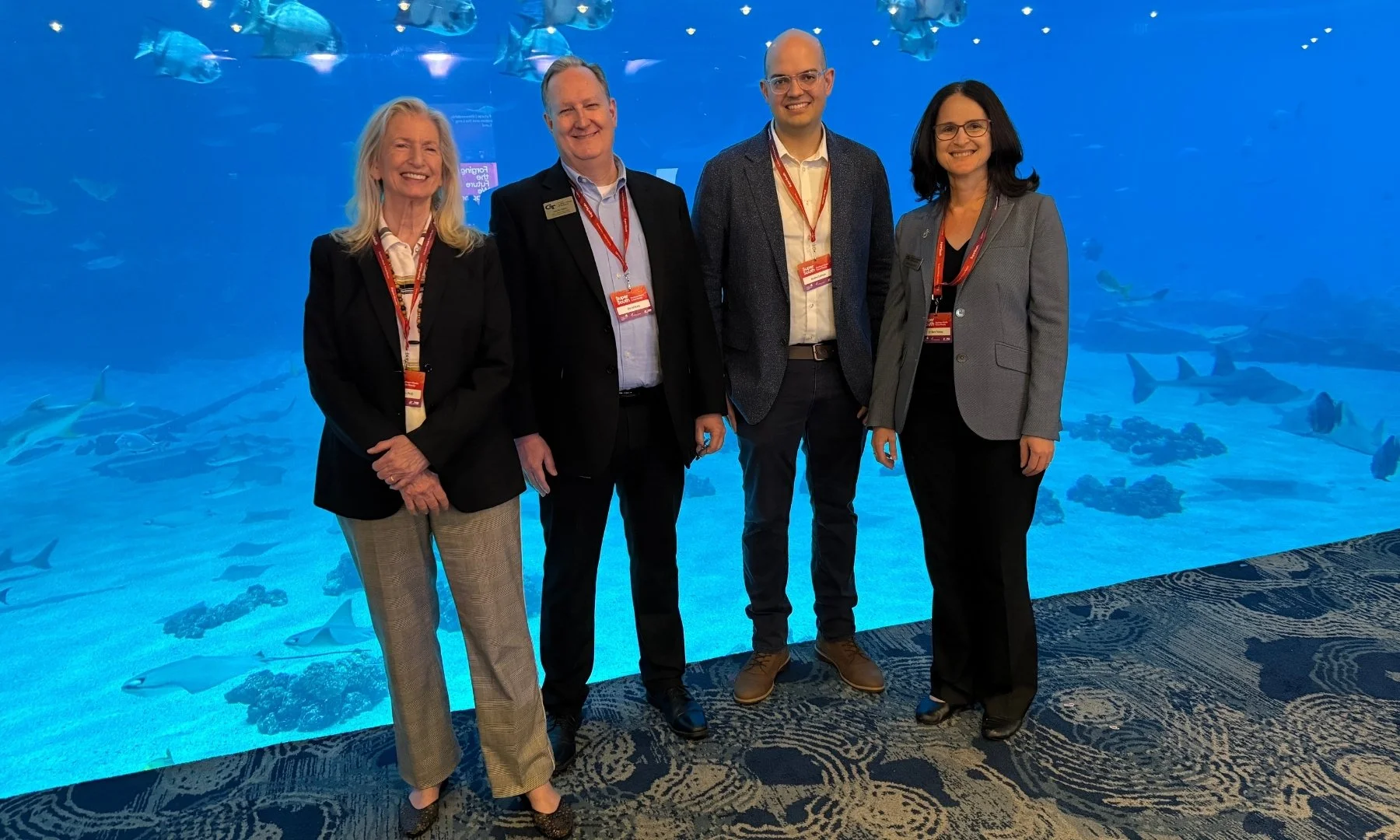
Marilyn Brown, David Eady, Andre Calmon, and Beril Toktay.
SUSTAIN-X: Next-Gen Entrepreneurs
SUSTAIN-X, a Center initiative that provides mentoring and resources to Georgia Tech startups with social and environmental impact, showcased six student and alumni ventures building scalable solutions across energy, materials, and everyday systems:
Raccoon Eyes uses AI technology to reduce food waste in commercial kitchens and has scaled to over 30 locations in three years.
Parkent is developing secure e-bike charging kiosks to address lagging infrastructure for the growing e-bike market.
Mycorrhiza Fashion is transforming textile waste – a significant source of environmental pollution – using fungi.
Jexim has reimagined asphalt technology to minimize energy use, carbon emissions, and environmental impact.
Reflex offers drone-based logistics for public safety and emergency medical supply delivery.
EnergyEase is an AI-powered platform simplifying energy efficiency for utilities, contractors, states, and residents.
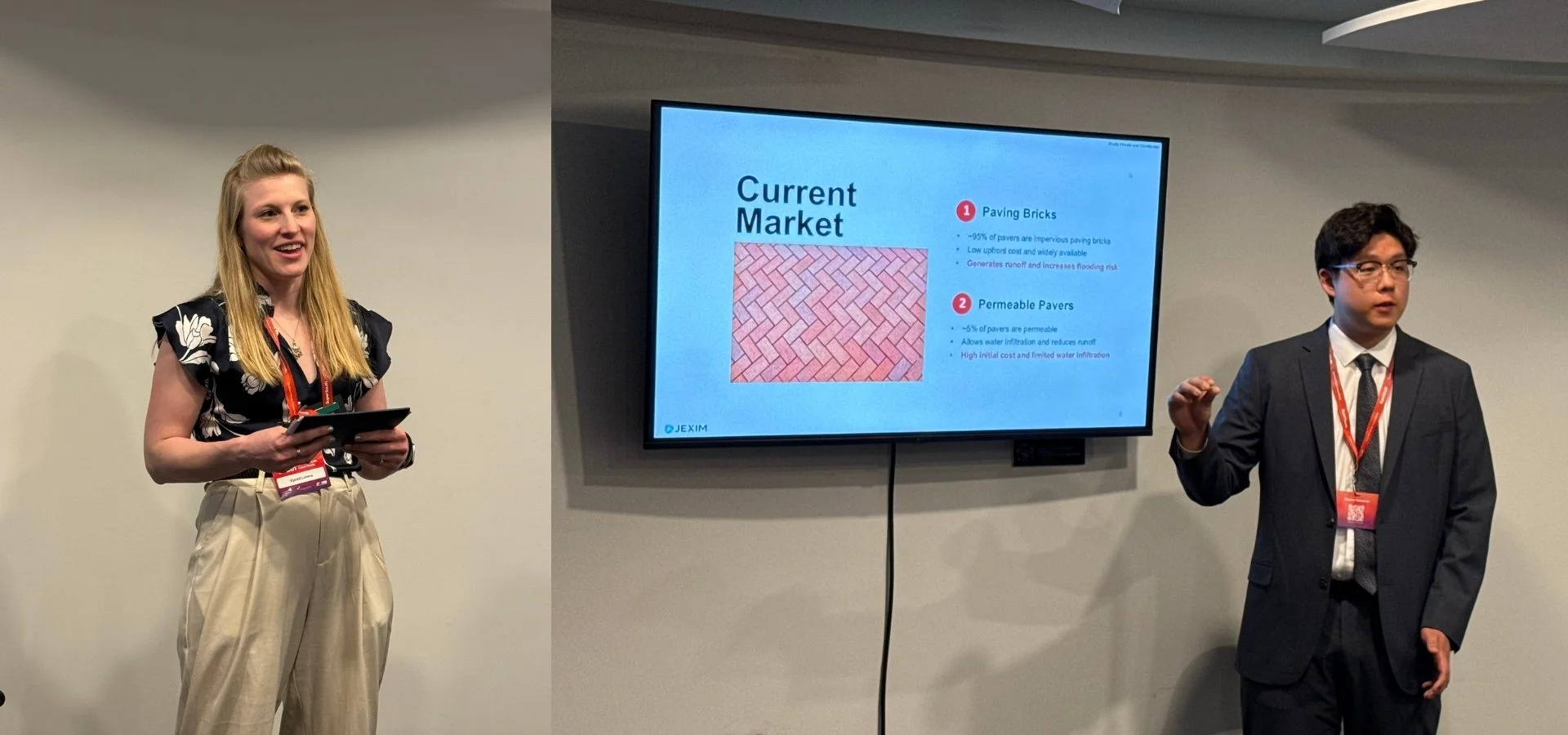
Kjersti Lukens, program manager for SUSTAIN-X, and Joel Lee, founder and CEO of Jexim.
Nature-Positive Capital: Investing in Restoration at Scale
A panel on nature-positive capital examined how corporations, land stewards, and market platforms are mobilizing carbon and biodiversity finance to restore ecosystems and generate durable returns.
Lucas Clay, the Center’s extension professional for carbon market partnerships and initiatives, set the scene: Georgia is the nation’s top forestry state, and its landowners are generating enormous benefits – including water quality, biodiversity, and recreational use – that traditional markets have historically undervalued. The Georgia Carbon Exchange, developed in partnership with the Center, the Georgia Forestry Foundation, Clemson University, and University of Georgia, is working to help small-acreage landowners access carbon markets. Investments in a carbon market can reduce harm in the environment and lead to regeneration at scale.
Lisa Lord of the Longleaf Alliance shared efforts to restore longleaf pine forests, which once covered most of the Southeast but have been reduced to a fraction of their original range. “We want to support more forest and groundcover restoration. We nearly lost the critical practice of applying fire to the landscape; we have to restore that.” Lord described how the organization works directly with private landowners to provide stewardship resources and market access, noting that private ownership dominates forestland across the Southeast.
Trey Benincosa of Cox Enterprises reflected on the corporate perspective: “I worry that we’re sacrificing incremental solutions in the pursuit of perfection. Giving corporations a platform to do good is challenging in this environment.” Still, he said Cox is actively pursuing carbon reduction, water replenishment, and biodiversity goals in its real estate portfolio.
Alex Butler of Chestnut Carbon highlighted a landmark project-financing deal as a signal to the market: a $210-million non-recourse credit facility backed by a 25-year offtake agreement with Microsoft for CO2 credits. This is the first long-term bank financing package of its kind for nature-based solutions in the U.S. voluntary carbon market. “It's established that project-level finance for nature-based solutions is possible,” Butler said.
Panelists broadly agreed that scaling nature-positive investment requires greater standardization and price transparency, along with new financing instruments that can account for long time horizons, inherent risks, and the many co-benefits that forests provide alongside carbon. As Lord put it: “Why do we need to silo water, biodiversity, carbon? We need to stack these things together.”
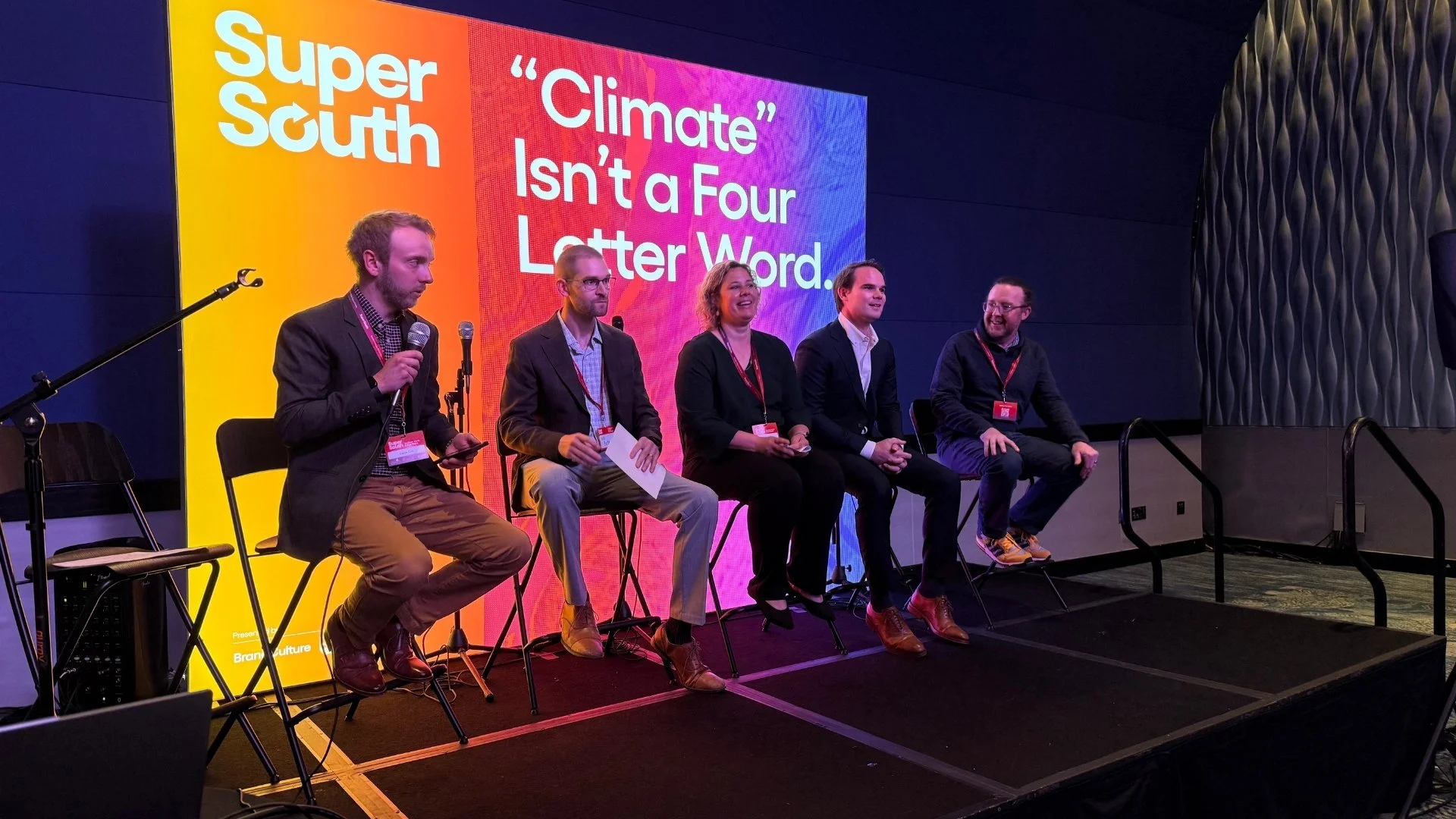
The nature-positive capital panel.
Georgia Tech and the Sustainability Ecosystem
The Georgia Tech sustainability community – students, faculty, staff, and alumni – took part in a number of other panels on energy, waste reduction, startups, and more.
The session, “Powering What’s Next: Innovation, Infrastructure, and the Future of Energy,” featured Bill Nussey, partner at Tech Square Ventures, in conversation with Tim Lieuwen, executive vice president for research at Georgia Tech, and Yuanzhi Tang, executive director of the Georgia Tech Strategic Energy Institute. The panel framed the Super South Energy Track – exploring how technology, policy, and capital are reshaping energy systems across the Southeast. Nussey said, “The potential for the Southeast is powerful – there are so many assets we can bring together.”
Jennifer Chirico, associate vice president of sustainability at Georgia Tech, spoke on two panels: the first on women leading Atlanta’s sustainability, and the second on enterprise strategies for waste reduction. Chirico, who began her career in finance, noted that she continues to believe it’s one of the most important things to understand in sustainability. She said that when it comes to implementing sustainability initiatives, people always ask, “What’s it going to cost?” She said, “Know your numbers, know as much as you can, because you’ll need to include [costs and ROI] in everything to do with reducing waste.”
Jennifer Singh led a discussion on how startups move “from breakthrough to business” at the Advanced Technology Development Center (ATDC), where she serves as sustainability catalyst. The panel showcased early-stage founders emerging from the startup incubator, a state of Georgia initiative which is based at Georgia Tech.
The breadth of engagement at Super South – from student entrepreneurs to seasoned industry practitioners, and from carbon markets to transdisciplinary research – reflects a maturing sustainability ecosystem in Georgia and the Southeast. Georgia Tech’s role as convener, researcher, and talent engine is increasingly central to that ecosystem, and the conversations at Super South underscored both the urgency of the work and the depth of the community committed to it.
Written by Jennifer Holley Lux
Photographs by Jennifer Holley Lux and Ben McDonald