

Georgia Forestry Foundation Publishes Students’ Mass Timber Research
The Georgia Forestry Foundation publishes mass timber research from a team of Scheller College of Business Graduate Sustainability Fellows.
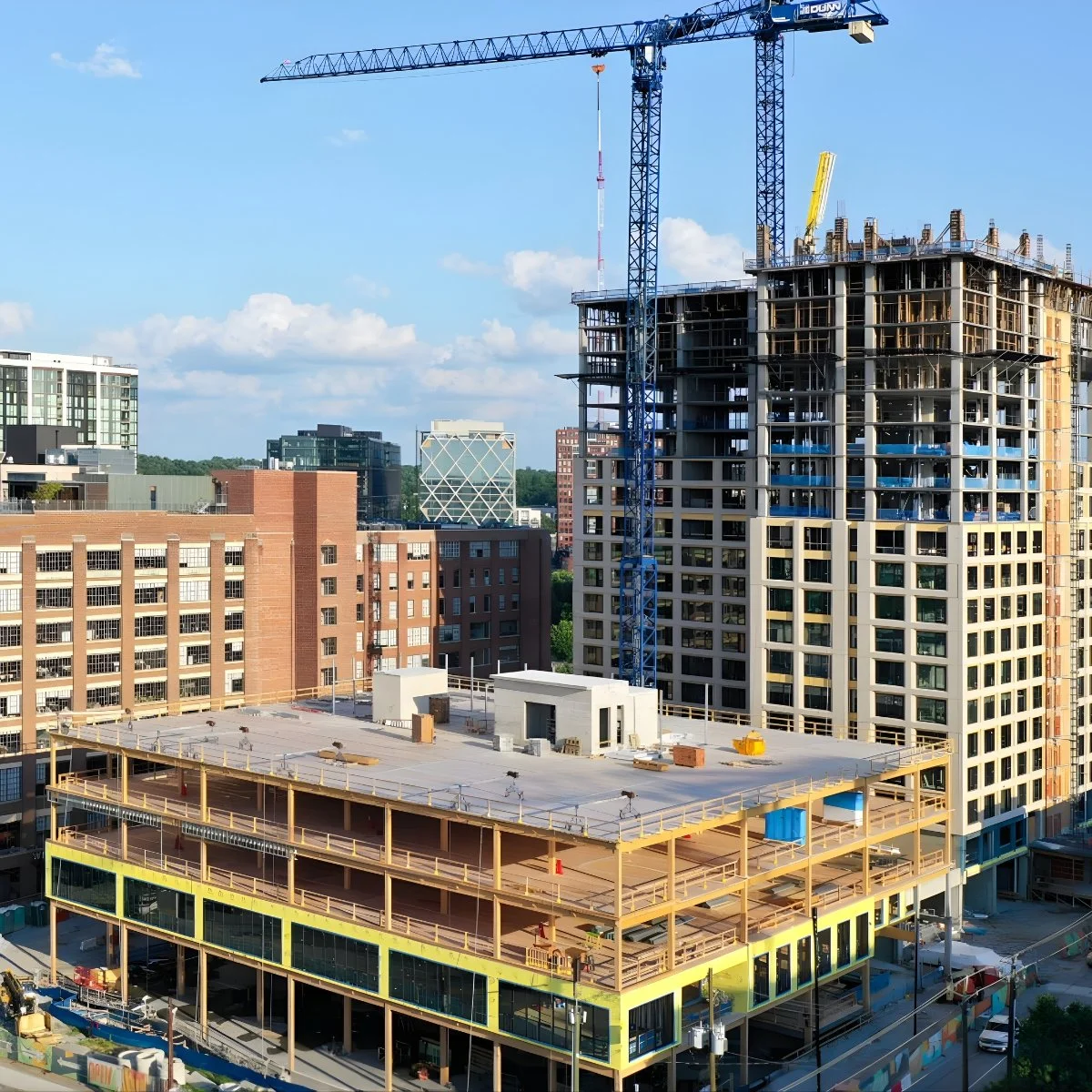
In 2023, the four-story 619 Ponce building was built with mass timber. Photo courtesy of Jamestown.
The Georgia Forestry Foundation has published students’ research on mass timber. The three students were 2023-24 Graduate Sustainability Fellows at the Ray C. Anderson Center for Sustainable Business. In the Fellows’ program, teams work together to address a sustainable business challenge or opportunity for a partnering organization.
A group of students prepared a paper promoting the benefits of mass timber construction. Using Jamestown as a case study, “Building with Mass Timber in Georgia” highlights the potential for locally sourced, low-carbon materials to transform urban development. Jamestown is the design-focused real estate investment and management firm behind Atlanta’s historic Ponce City Market. Students interviewed members of the Drawdown Georgia Business Compact (Compact) who toured 619 Ponce – a new mass timber, boutique office building adjacent to Ponce City Market. Students learned how buildings like 619 Ponce can help the statewide consortium of businesses achieve its commitment of net-zero carbon emissions in Georgia by 2050. The team of students, led by Allison Bridges, extension professional for the Compact, included Jie Kong (PhD student in earth and atmospheric sciences), Jay Mulay (IE ’23, MS QCF ’23), and Adrian Sandoval Carpio (MBA ’25).

Allison Bridges, Jay Mulay, Adrian Sandoval Carpio, Jie Kong
Case study highlights:
Mass timber construction focuses on using prefabricated wooden components joined by either industrial adhesives or nails.
Mass timber construction is more beneficial to the environment than alternatives like steel and concrete; it also outperforms traditional building techniques.
Mass timber construction has a high potential for success in the state of Georgia due to the state’s high reserve of suitable lumber.
When forests are managed responsibly, mass timber production can become a driver of long-term forest health.
For Georgia’s business community, mass timber represents a strategic opportunity to align sustainability goals with economic growth.
Mass timber development also supports local job creation, drives investment in rural economies, and strengthens regional supply chains.
As demand for low-carbon construction continues to rise, Georgia is well positioned to become a competitive hub for mass timber innovation.
Interested in learning more about this research? Contact Allison Bridges, extension professional for the Drawdown Georgia Business Compact.